Pricing Strategy: The Most Critical Decision You'll Make
Price it right from day one and everything else gets easier. Price it wrong and nothing else matters.
Of all the decisions you'll make when selling your home, pricing is the one that matters most. It shapes how quickly you sell, how many buyers you attract, how strong your offers are, and ultimately how much you walk away with. Get it right and the process flows. Get it wrong and you're fighting an uphill battle from the moment you go live.
Here's how I approach pricing — and why my approach protects your equity.
1
The Comparative Market Analysis (CMA)
Before we talk about a list price, I build a comprehensive Comparative Market Analysis — not a guess, not a number designed to impress you enough to sign a listing agreement. A real CMA is a data-driven assessment that examines recent comparable sales in your area, active competition you'll be measured against, homes that failed to sell and why, and current buyer demand trends.
The goal is to understand exactly where your home sits in the market — what buyers are actually paying for similar properties right now — and position you to capture the most from it. Knowing your market is the first step to pricing with confidence.
2
Three Pricing Approaches — and When Each Makes Sense
Every seller has different goals, and pricing strategy should reflect yours. There are three basic approaches:
Price to create competition. List slightly below market value to generate multiple offers and let buyers compete. This works exceptionally well in active markets and can drive the final sale price above asking. If speed and certainty are your priorities, this is your strategy.
Price at market value. List at what the data says your home is worth and let the market respond. This is the most straightforward approach — buyers see a fair price, serious interest follows, and the transaction moves cleanly. Best when convenience and a steady process are the goal.
Price above market. Target a very specific buyer with the means and motivation to pay a premium. This requires patience, a compelling property, and a realistic understanding that it may take longer. It works — but only when the home genuinely justifies the premium and the seller has the flexibility to wait.
We'll discuss which approach fits your situation, your timeline, and your financial goals — and build a strategy accordingly.
3
The Real Cost of Overpricing
Overpricing is the most common — and most costly — mistake sellers make. Here's what actually happens when a home is priced too high:
A
You repel the right buyers. Buyers doing their homework know what comparable homes sell for. An overpriced home gets skipped entirely — not considered and rejected, just skipped. The buyers most likely to love your home never schedule a showing.
B
You attract the wrong attention. Extended days on market signal to buyers that something is wrong — even when nothing is. Opportunistic buyers who see a stale listing immediately ask for steep discounts. The longer you sit, the weaker your position.
C
You create appraisal risk. Even if you find a buyer willing to pay your price, their lender's appraiser won't. If the home doesn't appraise, the buyer may be forced to walk — or you'll need to reduce the price anyway, this time from a position of weakness.
D
You exhaust yourself. Keeping your home show-ready for weeks or months while carrying the costs of ownership is stressful and expensive. Every week on market is a week of mortgage payments, utilities, and maintenance — plus the emotional toll of uncertainty.
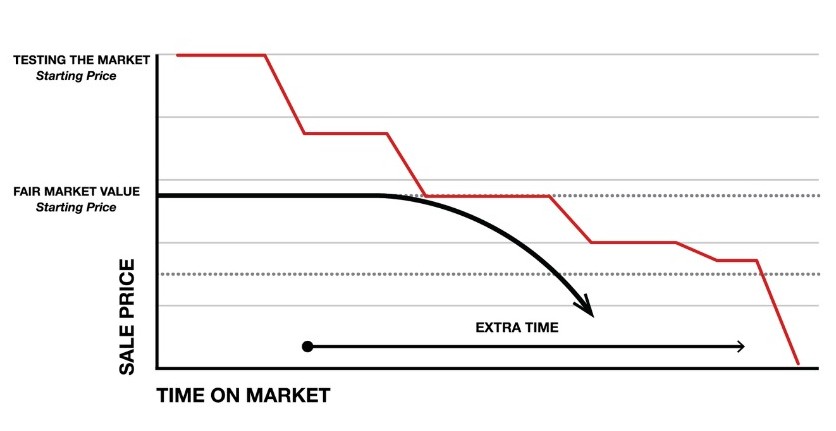
The data is consistent: homes priced correctly from the start sell faster and for more money than homes that start high and reduce. The best time to attract a buyer is the first two weeks your home is on the market. Don't waste that window.
4
What Happens When You Have to Reduce
Price reductions are visible to every buyer watching the market. When a home drops in price, it raises questions — "What's wrong with it? Why hasn't it sold?" — that are hard to answer even when the answer is simply "it was priced too high." A reduction that brings you to where you should have started rarely generates the same excitement as a correctly priced new listing. You only get one first impression. Price it right and make that impression count.
5
My Commitment to Honest Pricing
Some agents tell sellers what they want to hear about price to win the listing — then start asking for reductions a few weeks later. I don't work that way. My pricing recommendation is based on data, market knowledge, and a genuine commitment to getting you the best possible outcome. If the market tells me your home is worth X, I'll tell you X — even if it's not the number you were hoping for. An honest conversation at the start saves everyone time, stress, and money at the end.
Let's Talk About What Your Home Is Worth
Pricing starts with a conversation and a thorough look at your home and the market. Let's set up a time to walk through it together — no obligation, just honest numbers and a clear strategy.
(678) 939-1941 | patrickwalters@kw.com
Patrick Walters is a licensed Associate Broker and REALTOR® (ABR®, SRS) with Keller Williams Realty Signature Partners, serving the Metro Atlanta market. License #322282. Pricing recommendations are based on market data and professional judgment and do not constitute a guarantee of sale price or outcome.